
Back in the saddle again
Okay, not a horseman, which I’m sure relieves a number of equines out there, but the saying holds true. I put this blog on hold for a while because of the fire we had in Paradise, CA, where I live. And yeah, like most of …
An electronic version of the notebook in my haversack
Okay, not a horseman, which I’m sure relieves a number of equines out there, but the saying holds true. I put this blog on hold for a while because of the fire we had in Paradise, CA, where I live. And yeah, like most of …

So far, all of you have been very kind and not told me to “Shaddap”, because I know I can get rather long winded, especially when my “Obsession” button has been pressed. To reward you for your patience, I have here a guest poster, a …
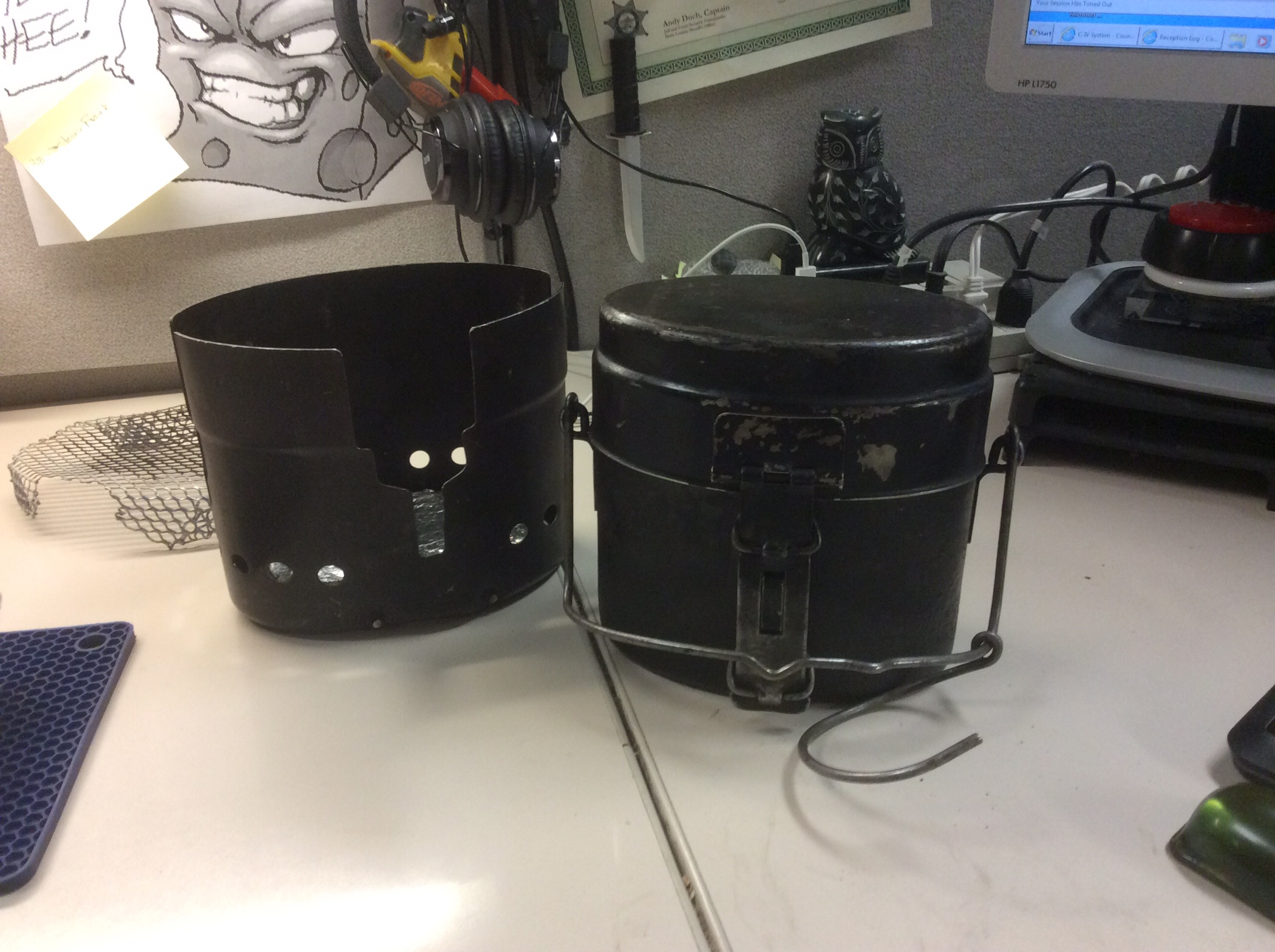
So, we had a single-day SCA event today, a local one. Just a few miles from the house, so of course that meant we had to fill the car with stuff. Sunshade, chairs, tables, small ice chest, my Microkitchen…you know, the bare essentials.
There was also a “groaning board”…medieval-esque for a pot luck, and yes, I have a “thing” about cooking food on site. So, I planned for food I could prepare there.
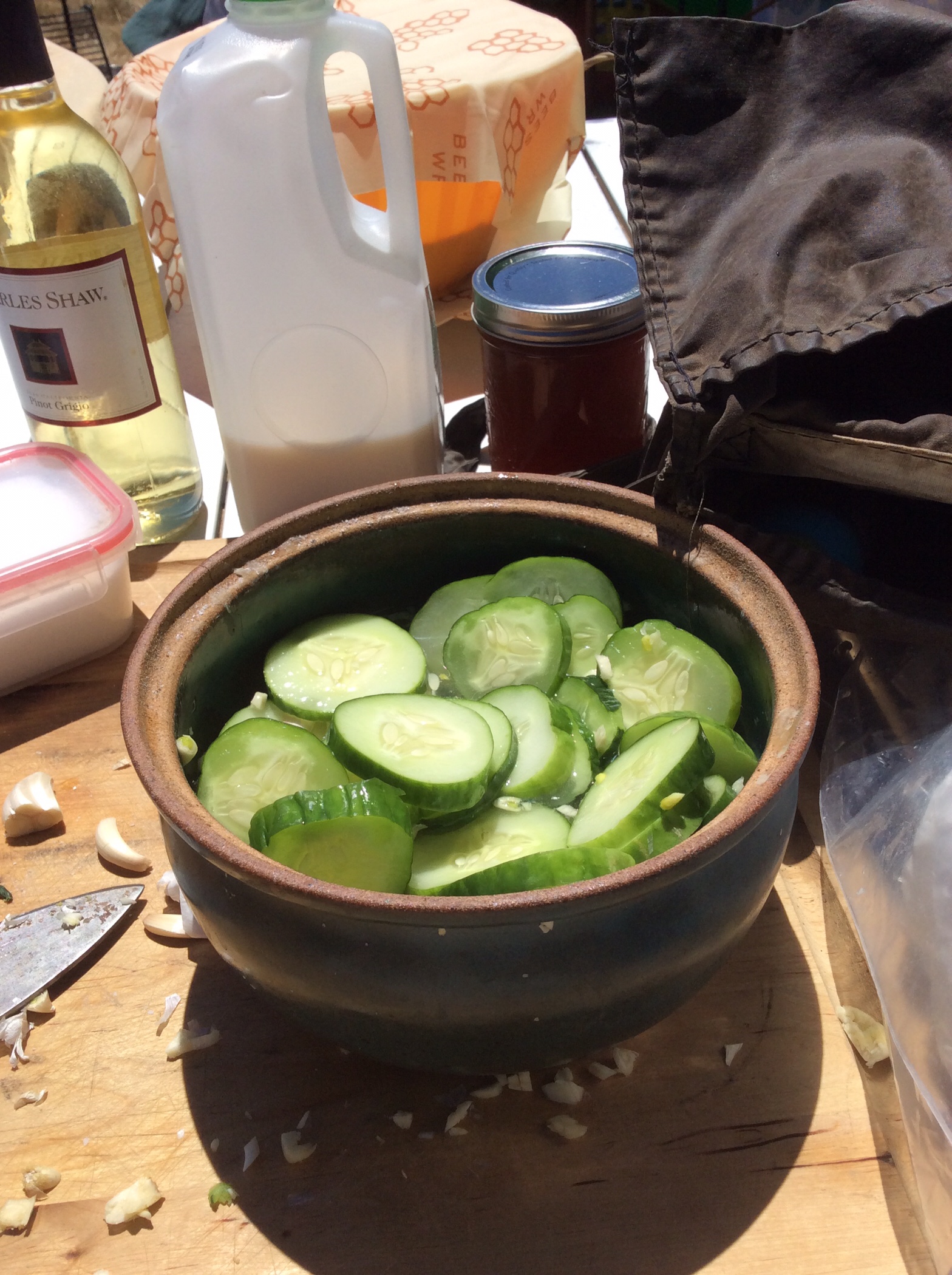
First up…the Transylvanian cucumber salad. I’ve made this before, it goes down well with people who might be leery about trying “medieval food”. It’s also really easy to make with a minimal kitchen. You can see the recipe elsewhere in the blog, but it’s basically sliced cukes with salt, pepper, olive oil, wine vinegar, and finely minced garlic. Toss in a bowl, and let it sit. It’s vegan-friendly, gluten-free, fast, and cheap.
Next…well, pot lucks are often light on proteins…but I didn’t want to bring a big, heavy kitchen setup. To me this says pre-cooked meat of some sort, and a period sauce. Flipping through the Transylvanian again we get…
Fifth. (594) Sour cherry sauce.
Clean the sour cherry in a clean iron pot. Add some wine; a bit of white bread and honey, then cook it, pass it through a strainer into a plate and add some black pepper; but don’t add clove, add cinnamon instead; cook it together, but don’t make it too thick.
This followed a few recipes for bird sauce, sauces that go on spit-roasted chickens, and it certainly sounded like it would be good on a chicken, so…one quick trip to Costco for a rotisserie bird ($5 for a good-size, generically seasoned rotisserie chicken that’s already cooked? And tastes good on its own? No-brainer!). Those prior two recipes call for slicing the chicken off the bone and into the sauce, so I did slice up the chicken meat. Meanwhile, one jar of pitted morello cherries (which are decently sour), maybe a half cup of dried sour cherries (I like cherries), a cup and a half of white wine, the insides of a sandwich roll, hollowed out and hand-shredded into crumbs), a quarter cup of honey (by eye), and about a teaspoon each of ground cinnamon and black pepper. Bring to a simmer, mashing things up a bit since I wasn’t going to push it through a strainer. It did get a bit thick, so I added a half-cup of water, and did it again later as the liquid cooked down. Poured the sauce over the shredded chicken, and voila, service! Taste–delightful, will make again. I especially like the idea that this uses specifically an iron pot, as opposed to the likely more common bronze…the acidic cherries would have not done well in bronze…and thankfully, my small iron pot fits neatly on the Microkitchen stove.
Next…well, I was surrounded by demanding people and thus had to (was forced under pain of extensive whining) make Digby’s Toasted Cheese….aka Digby’s Evil Cheesy Goo. It’s a recipe from just barely after the SCA’s stated time period from The Closet of Sir Kennelm Digby, Open’d and it’s really very good, albeit high enough in calories I do not make it alone. Think terribly rich fondue made from equal parts butter, Brie, and cream cheese (so, a stick of butter, a standard wedge of Brie, and a brick of cream cheese, melted together over low heat and stirred until it all comes together.) You can add other cheeses, or things like garlic and black pepper. I kept it basic so it would appeal to as many as possible. It’s good on sliced bread, sliced tart apples, broccoli, a spoon, your fingers, an old shoe…
Last…I had several possibilities, most of them not medieval and mostly for my own gustatory pleasures. But….you remember that one little package of octopus from last week? When soaked and lye-worked it made for quite a few little tentacled buddies. There were SIX more I didn’t cook, so after their little boiling step, I ziplocked them and tossed them into the freezer for later use. And they came with me to the event. After all, there were people coming to the event that were interested in my results. So I quickly thawed them in cool water. Half of them I bundled up and impaled on skewers (the Microkitchen being well stocked)…and this time I had learned to wrap the tentacles up in the body, so it stayed as a nice, mostly neat package. Olive oil drizzle, some black pepper, and this time, a bit of salt, and a few minutes roasting over the alcohol stove burner. I had to cajole some folks into it, but no one who tried it thought it was horrible, or spat it out. So that was a win.
With the last three I wanted to try the other octopus recipe:
First. (412) How to soak octopi.
Make some holes, clean it and let it soak in lye. Once done, wash it in cold water, boil it, cook it in vinegar. It’s good to fry it with oily sauce. Make thin slices, and make a sauce with black pepper, saffron, vinegar, tree oil and honey.
Thing is, this reads to me like several different recipes. After all the rehydration stuff discussed in the second recipe, you have options. You can cook it in vinegar. You can cook it in “oily sauce”. Or you can cook it with what sort of appears to be a vinaigrette with black pepper, saffron, and honey. Oh, but there’s more. I looked up oily sauce. It’s mentioned quite often in amongst the fish. I hit the Mother Lode under dried sturgeon:
(293) Dry sturgeon with oily sauce.
There are three types of oily sauce. One of them is made from cabbage sauce, the second is made from water, oil, vinegar and onion. The third is made from wine, tree oil, honey, some grapes, apple, onion and dill. You shall find out how to cook the dry sturgeon among the beluga.
Dried sturgeon…dried (and rehydrated) octopus…So it appeared I had a choice of onion-rich cabbage broth with olive oil, the same with no cabbage, but with vinegar…and then number three…wine, olive oil, honey, grapes, apple, onion, and dill. Hey, that sounded interesting. Lots of flavors, there. So I made it. All by eye, maybe a cup of wine, half a cup of small green grapes, quarter cup of honey, a few tablespoons of olive oil, about 1/3 of a nice tart apple chopped small, and a good teaspoon and a half of dill, with a little minced onion. The Microkitchen doesn’t really encourage exact measurements. Because they were out on the table, I also added a few threads of saffron and a pinch of black pepper as flavors mentioned from the original octopus recipe. Brought that up to a simmer, chopped up the last of the octopi, and added it in.
Well. That was pretty surprisingly darned tasty. The octopi practically vanished into it taste-wise, being more texture than anything else. Added a subtle fishiness, like a hit of fish sauce or garum, but nothing huge. My main taste tester here (pictured below) REALLY liked this.

Hey, um, Siobhan, you have a little something on your lip…
By the bye, Siobhan has been testing other Transylvanian recipes and will be guest-posting them here.
But now it’s really bedtime after a long day. See you next time!

…in which our brave hero, having deciphered the cryptic manuscript, quested for and received in turn the most necessary Ingredient, and followed all the steps of the Dance Culinaire, does finally put the pieces together and assemble the Dish at Last. Well. Yeah. We did …
I love much about my job. Especially on days like today, because you see, I have a flex schedule, and 4 ten hour days, meaning Fridays off every week. This is relevant because when you have a big project, like doing 72-hour short ribs in …

Okay. I know I can be maybe a trifle obsessive when it comes to cooking medieval recipes. It’s not enough to be actually cooking dishes based on sometimes-fragmentary and unhelpful recipes that are occasionally not even in anything resembling English, but then I have to cook with handmade period equipment, over fires.
And that’s fine. That’s just who I am. But sometimes, I have to take it further. Pick a crazy recipe to go with. Pick recipes where you have to make ingredients first to make the finished product. Find truly bizarre ingredients. Do stuff that has your friends cheering you on…but only at a minimum safe distance.
That’s where I am today.
The Transylvanian Cookbook, known as the Science of Cooking, has some unusual foibles. The writer was obviously a firm nationalist, but he(?) was obviously well travelled, as he wrote about seeing the Hungarian Emperor at dinner (hey, bro, more detail would have been nice!), talks about recipes from other countries, and he uses ingredients not found in that area at all. Which brings us to the two recipes for octopus.
Octopus isn’t native to the region at all. The nearby Black Sea is too salty for them. The nearest place you might find them would be the Mediterranean or Aegean Seas, which are an uncomfortable number of hundreds of miles from Transylvania, even given that they knew about using ice to keep foods fresh, longer. So these two recipes must be truly exotic dishes to please very high class people, since you’d have to catch them, dry them thoroughly, and then ship them up to Transylvania in sufficient quantity for your feast. And, as one often finds with high class foods, you have to do a lot to them to make them even more special for your lord or prince.
Here’s what I’m working with. And all credit to my friend Tiffany, who found the dried octopus to begin with. No, credit is NOT another word for blame!
Let’s talk about octopi
First.
(412) How to soak octopi.
Make some holes, clean it and let it soak in lye. Once done, wash it in cold water, boil it, cook it in vinegar. It’s good to fry it with oily sauce. Make thin slices, and make a sauce with black pepper, saffron, vinegar, tree oil and honey.
(413) Octopus in a different way.
Wash the octopus in three pots of water, then let it soak in clean water for two days, but change the water frequently, especially in the summer, elsewise it will go bad. Once you put it in a new pot of water, wash it. Once two days have passed, make some alkali out of ash, but don’t make it too strong, for that will devour the fish, and your lord will be angry with you. Let the alkali cool, and put it in the same pot with the octopus, let it stand for one night, then boil it in clean water, pass through a strainer the water, put it in cold water, and keep it with ice in the summer so that it will not go bad. Once you’re about to cook it, remove the black skin, put it on a skewer, roast it, paste it with tree oil. Once done, put it on a skewer and add some black pepper, then serve it while it’s hot.
Yes. This is lye-cured octopus. Octo-lutefisk, if you will. Fish-jello, with tentacles. Oh, heavens, what AM I about to do?
Okay, that first recipe? Too simple, and some details are missing, like how long you soak it. Maybe I’ll try that one if I get more octopus and recipe 413 doesn’t kill me. No, I’m going for the gusto.
So if I’m doing this, I will need to plan carefully. When you read the recipe through, one of the first things I notice is that we are talking about something that’s going to take three days, minimum, to prepare. As I have a real life outside the kitchen, this means starting it on a day when I’ll have time to follow all the steps, especially when I get to the night of the second day, and cook it on the third day. Because I can’t just do it on the stove, no. I’ll have to do this over a medieval cooking hearth, using a period heat source, and period cookware, and both of those mean time consuming.
Wait, let’s back up. Making alkali (lye) isn’t hard…it’s a matter of straining water through wood ash (preferably hardwood). So I’ll need a supply of ash. I can do that, but given the fire season, let’s do that carefully, hmmm? How strong do I make this? Since I’m no longer taking college chemistry classes, I no longer have access to a phenolphthalein titration rig (not that that would help as our cookbook author forgot to give us a nice pH for the solution).
I’m going to have to reach outside my source for this one. Some post-period references talk about making lye “strong enough to half float an egg”…in other words, the concentration of lye for a strong solution would float an egg halfway out of the water. There is a lovely analysis of the process here: Lye Making and here: More Lye Making . Okay. Traditional lutefisk has a pH of between 10.5 and 12 per Google (yikes, that’s high). Our recipe says to not make it strong so I think we should aim low–besides, with a lower pH, we can always soak it a bit longer if we have to. Too high, and the octopus will dissolve and our lord will be angry at us. Thankfully, that second link shows a means to make an easy pH testing solution and provides a color testing scale.
So, now our first step is going to be to get the lye ready in advance, testing it to make sure we have it not too strong, but not too weak, either. Then we can rehydrate the octopus for a couple of days, soak it overnight in our home made lye solution, and on the last day, peel it, put it on a skewer, season it up with some good olive oil and fresh black pepper, roast it over a fire…and taste it.
It’s too late tonight to start making ash, and I don’t have a red cabbage on hand to make the pH testing liquid. But we have a plan. Stay tuned friends, and let’s see how this works!

This is also known as “Cook All The Things” Day, and it’s kind of bittersweet. No one holds back, but that’s because we have to pack down and go home the next day (actually, given the amount of sheer stuff we have, most of us …

Yeah, now I was hitting my stride. So was everyone else. Friday at the War for the Cooks’ Camp generally means Fish Friday (so very medieval), though there’s no requirement to do it if you’re not into fish. Since dried octopus wasn’t to be found …
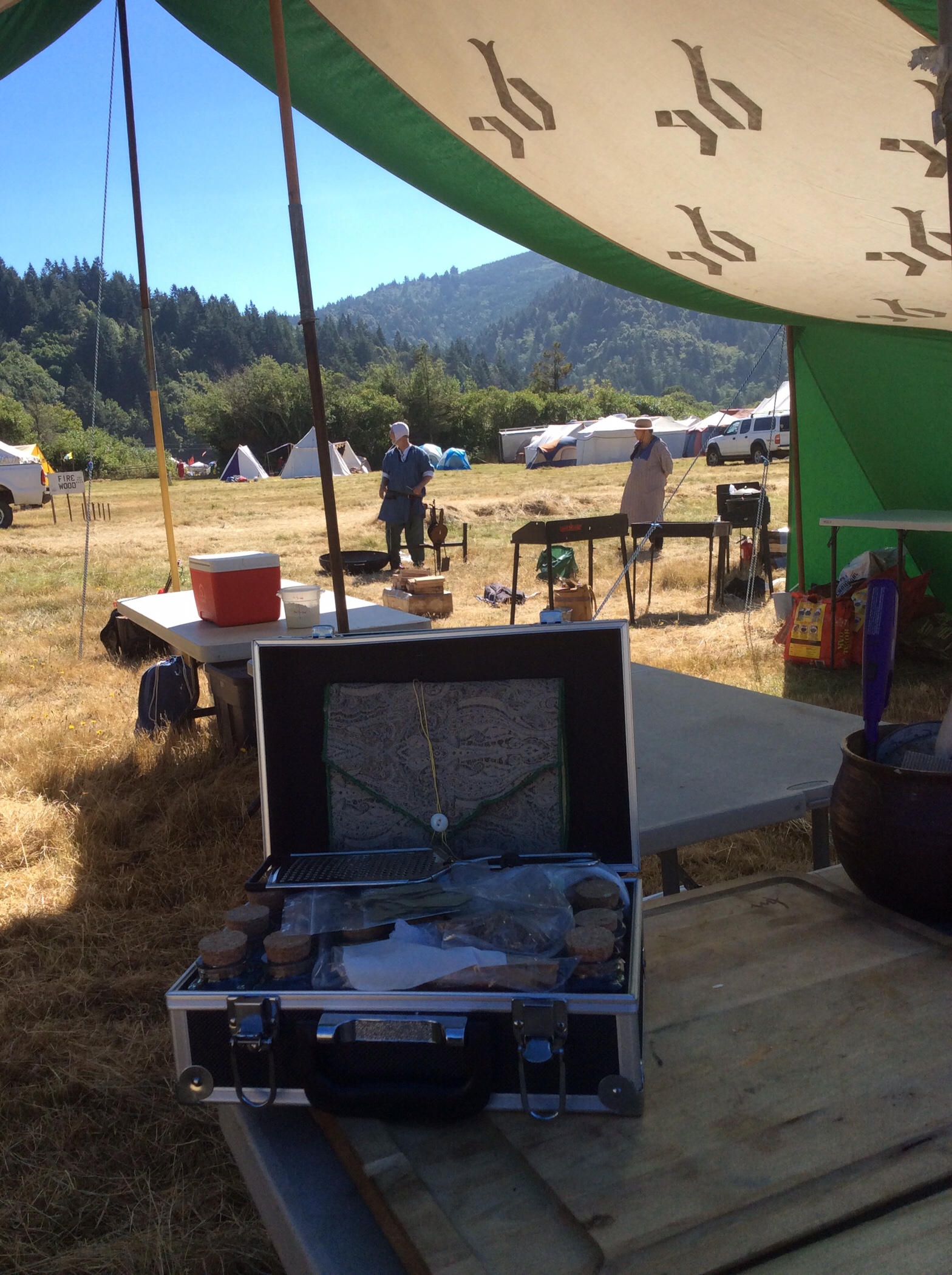
Wait, you might cry, what happened to day one? Day one was Wednesday, aka set-up day. And when you have a large pavilion, a huge pile of gear to move from truck to ground, and from ground to where it goes, plus the bed, stuff for the outdoor kitchen space and my own personal in-pavilion kitchen space to set up, it takes a while. Plus helping out ones neighbors as one should do. Plus the four hour drive from Grant’s Pass, and getting back into town for dinner and getting a few extras at the local market. So yeah, cooking-wise, Wednesday was a bust, as it always is.
But day two, we get rolling. Sure, we have to unpack our supply of pipkins and rummage through the ice chests and dish out our recipes, but that’s why we are here!
So, here’s what I cooked on Thursday.
I first tried something not strictly period…I mean, I’m sure it is, but it’s not documented, since I was otherwise working more or less exclusively with the Transylvanian cookbook, The Science of Cooking, this time around. I had this big honking pork shoulder, bought for cheap. So I deboned it, and butterflied a section of it out, and then mixed up some sausage that was intended for dinner the night before (but we went out instead) with eggs, some spices, and some breadcrumbs. The idea was to roll the pork around the filling, tie it up, and roast it over the fire. Alas, it just never came together because the piece of meat was too small and since I was still working slowly I eventually disposed of it because it had been out too long. It probably would have been okay, but dealing in probably will get you sick at so3 point. No big loss. No picture either, which is fine because it was ugly.
Second, ah, a recipe! The Garlic Harvest Sauce is probably my favorite sauce in the whole manuscript, which is good, because it’s used so often. So, this time I did it with the remaining pork, and for the first time I did it using truly period cookware…I.e. in a Pipkin over a fire.
Twelfth. (151) Pork with harvest sauce.
Prepare the pig like I told you to. After the meat is tender, slice some onion and parsley leaves. When serving it, make harvest sauce. Don’t forget to add spices.
Not overly informative, no, but recipes (2) and (3) from the manuscript give very solid details on how to make harvest sauce. And see my earlier post on making it with beef on A Tale of Two Weekends. Since I was making a large pot of this, I made rather a lot of the sauce,and honestly, I should have grabbed two more eggs from the care basket that Tallina sent up to the War (period nut candies, unripe grapes for verjus, a dozen and a half free range chicken and duck eggs, rice flour, GOOD local olive oil…). Her eggs were great golden and tasty, but I needed a few more than I used to properly thicken the sauce. So, what I ended up using was:
3 pounds pork shoulder, sliced into smaller pieces, simmered in 6 cups water to make a pork broth with the pork cooked tender.
5 duck eggs beaten with 1/4 white wine vinegar
3 parsnips (in place of the parsley root)
Half a yellow onion
Leaves of half a bunch of parsley, chopped
Ginger, saffron, and black pepper to taste
Salt to taste
This ended up being one of my contributions to dinner that night and was enjoyed, especially by our post-dinner visitors.
Picture: I didn’t get one, darn it all.
The other thing I cooked was:
Fifth. (86) Lamb with onion sauce.
Cook the meat like I told you; once about to serve it, slice it to the pot, and do this with the sauce: peel the onion, slice it on a clean table then put it into the pot, put clean beef (broth) on top of it, cook it, and while it’s being cooked, add some vinegar, black pepper and pour it into a pot with the lamb, then serve it once both are ready.
And our author told us in the previous recipe how to cook the lamb–salt it, roast it over the fire until it was done, then hit it to knock the salt off. Now, I don’t know if the salt fell off particularly, but we did get some juices, which I dutifully put into the Pipkin with the four very large, amazingly tasty lamb loin chops (the site owner offered us his lamb for only the cost of having it butchered–an amazing deal, and talk about terroir!).
So, about two pounds of lamb, an onion and a half (diced with the lamb), about three cups of beef broth (made with Better Than Bullion…awfully convenient stuff, that!), and a quarter cup of red wine vinegar. Pepper to taste, maybe a teaspoon or so. Simmered a couple of hours and also served at dinner.
I would happily eat this again. And not share it.


Meanwhile, our resident artificer, Aram, had started working on the oven…


But I wouldn’t want you think I’ve been ignoring this blog. No, I’ve been getting ready for an event that’s fairly important to me, and now that the event has come and gone, I can write about it. You see, this past week (well, five …

If you know me, or have gotten a sense of who I am from these articles, you know I am a little strange. I’m not a terribly tidy person, not really, but I DO prize order and organization. I love lists. I like to compartmentalize …
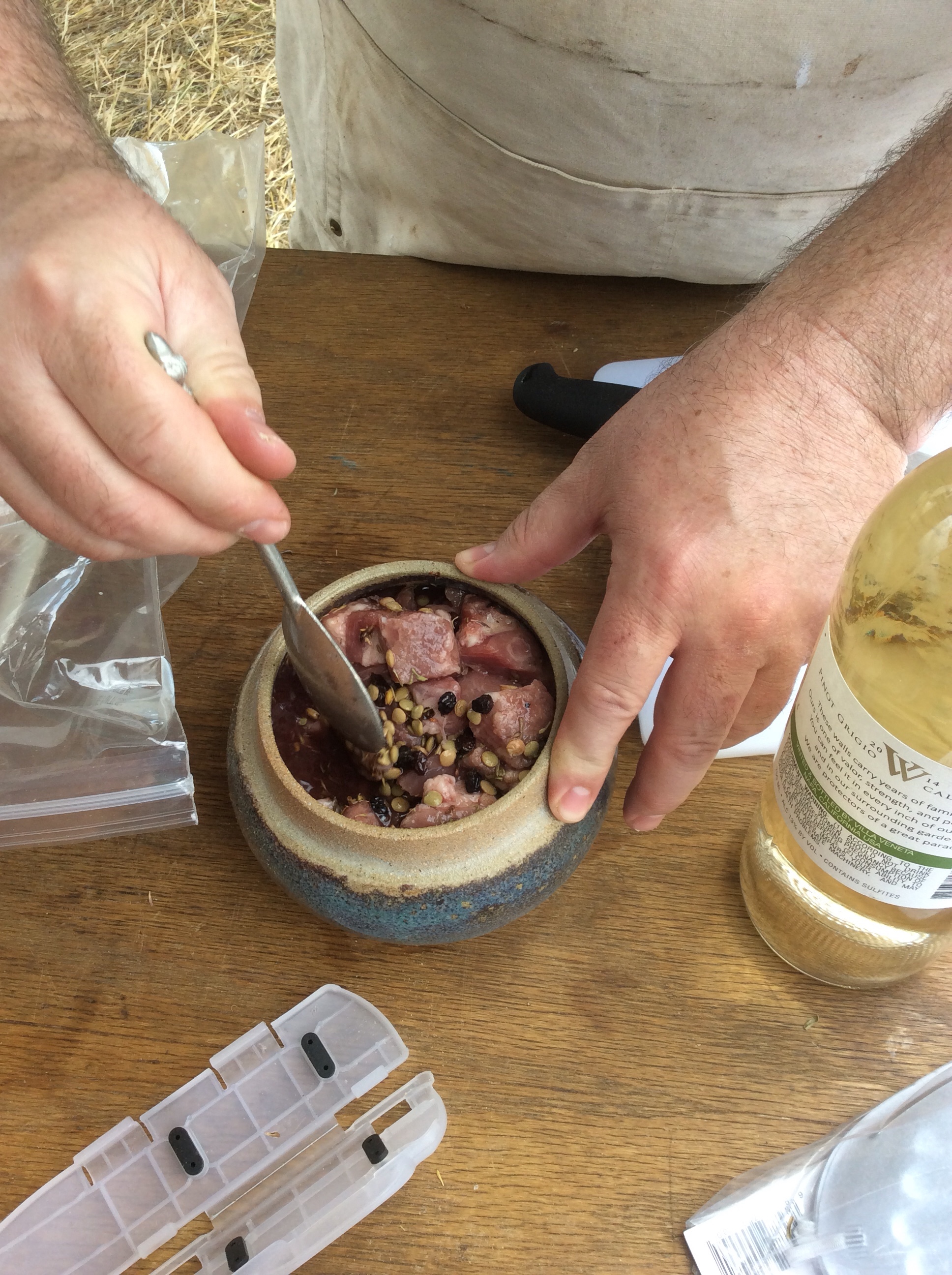
So, I have a pretty decent collection of medieval cookbooks these days, and of course there are SO many more available for free access online. To the folks who read this, my question is this: What three to five SCA period cookbooks, in order, do YOU consider essential and most representational, and why? Yes, I know your choices show your particular bias in studying period food, but that’s okay. Pretend you have a tiny amount of space to pack some period cookbooks…which ones are coming with you? Please post your answer in the comments.
My top five?
Of course this list changes depending on mood and what I’m into at the moment. But now I want to know yours. So….go!

So, what with all the SCA wonderful weirdness hitting my life this second, I felt the need to actually wrap up the 3.0 edition of the Transylvanian Cookbook. This is, realistically, probably the last major update I’m going to do. If I start doing more …
So. Last weekend we had a local SCA event. I was going to keep it simple. I was going to reprise those fried cheese sticks because yum, and a bunch of friends wanted to try them, and I was also going to do the Bird …

You know the story…the centipede was walking along, and someone asked it, how can you keep track of your feet? And the centipede stopped, and actually thought about what he was doing, and was never able to walk in a coordinated fashion again.
Well, hopefully I’ll be able to avoid that. A good friend asked me how it was that I could read a medieval recipe which made no sense to him, and write out something that did. I was my usual flippant self, but realized he deserved a better answer. So this one’s for you, Paul. And anyone else who wants to take a trip into my brain. Caveat: this is only MY process. Other people have theirs, which serves them at least as well.
Okay. So you have a medieval recipe. We’ll assume it’s either in an English variant, or has been translated, because translating is a whole ‘nother ball of dough. Though it may well have words that aren’t English or are used differently, and that’s okay.
First step: remind yourself that what you’re reading is NOT a modern recipe. A modern recipe has a goal, and that goal is to teach you how to make that one dish, just the way the author says. In our modern format, we have this nice, sensible list of ingredients, with nice measurements, sometimes with sub-instructions (1/3 cup carrots, small dice). Then it logically moves into what you do with those ingredients, and maybe has a picture of the final product, so you can check your work.
Yeah, that’s not at all a medieval recipe. Medieval recipes are NOT supposed to teach you how to make a precise copy of dish X. Most of the time, these cookbooks were collections of notes of some highly skilled professional chef who was jotting (or had someone jot) reminders about the dish, more often than not with instructions on how his boss specifically liked it, perhaps for someone following him. Later published cookbooks were basically bragging rights (“this is what MY most awesome chef cooks for ME, because I’m a wealthy noble!”). To make it more challenging, these books that we end up with are generally hand copied copies of a copy of someone who might not have written well to start with. But don’t despair. Just remember, what you’re looking at has only a vague connection to what “The Joy of Cooking” might have.
Second step: read it a few times. Especially, read it out loud. I mentioned these things might have been what a scribe jotted down on the mutterings of a chef, right? This helps return it to its original format. In some period cookbooks, even it feels very much like a conversation the cook is having with his audience, a room full of students. Reading it out loud helps you make sense of it. This is extra-true with older English, when the words are more phonetic than you’re used to. When it’s out loud, it feels more natural to say “Do this, then do that…oh, I forgot to say do this other thing first, and did you get your oven hot?”
And when you’re reading, especially something that’s a translation, is there something that just doesn’t belong? People make mistakes, and the more hands and eyes that come before you get it means more opportunities for error. So stay aware that an error could creep in at any point, and that if something seems like a mistake…it might be one.
Third step: this one is the kicker. You have to -decide- what the end result is going to be. It’s counterintuitive, but I’m the absence of a helpful picture, or a labeled section of cookbook (like: “Pies”, or “Sauces”), this is your call. This says it’s a pottage. Is it going to come out as a thin soup, a thick stew, meat with some sauce, maybe a custard…how about a pie filling you scoop out of a pie after baking? All these and more are things I’ve seen labeled as pottages. So you have to read carefully. To this end, I have what I call “filters”—each pass through the recipe I look at it with a different filter in mind, to help me build up a picture of the final product. These filters can also help you deduce any missing or out of order steps in the recipe.
—First filter: what do I know about the ingredients called for…what will they do? I’m adding eggs to the soup and beating it without letting it boil…sounds to me they’re using the eggs as a thickener, like custard, not as a component of the soup, like egg-drop soup. Or “make it yellow with saffron”…so to spread the color, I’d want to add it to the broth I’m cooking that rice in, rather than just sprinkling it on the final dish. A good cook can even predict why some instructions are in there (in the fried cheese from my last post, it says only too cook the batter until it’s yellow, not golden brown, which as we know is delicious. Why? Because if you cook it that long, the cheese will completely melt and boil out of your crust and burn, and you will be a sad chef). This is also where knowing the difference between modern and medieval ingredients is important (a -dozen- eggs? Oh, yeah, eggs were smaller then).
—Second Filter: Cooking technology. Knowing what they had to cook with, with what materials, how energy was applied, and what their tools were, you can make a likely guess as to what the result will be. In the example about about the eggs and soup. “Okay, so they’re likely cooking this in a ceramic pipkin over coals. That’s going to greatly slow down the heating, making it easier to avoid the boiling and the clumping of eggs.”—voila, another item of evidence for your creamy egg soup.
You can even take this further…”so, Wood for fires is a scarce resource, what’s the most efficient way to cook this…boiling or frying or on a spit?” Or “why does this call for already cooked meat? Oh! It’s using leftovers from last night’s roast!”
—Third Filter: What did they -think- about food? This is the most tenuous, the one that takes the most experience…and it also can help you jump big holes in your original recipe…but it means you can be more wrong too. Let’s put it into modern terms. Suppose you know someone does the “Keto diet” thing. That gives you hints about what they’re going to eat and how to eat it. If their recipe says to “bread the fish” you could guess they’re unlikely to use actual breadcrumbs, and now you know you have to look for something a keto person might bread with that isn’t bread! It’s like that with period foods.
Through much of our period, people subscribed to two big food philosophies—humoral theory of foods, and second, a religious-based set of limitations on what you could eat at what time. While a big discussion of humoral theory is out of the scope of this particular article, it’s worth looking up (I recommend _Eating Right In The Renaissance_ by Ken Albala). Suppose you had a fish…humorally speaking, it would always be considered a cold and wet food, so you might want to use a cooking technique that was alleged to be “warming and drying” to balance that (like grilling it over a hot fire), or using other foods or seasonings to do the same (sour orange juice was a “dry” ingredient, so just pour some of that over the dish after cooking…). You’re basically teaching yourself the way to think they did.
With religion, if something is for “a fast day”, “a fish day”, or “for Lent”, you KNOW that if you’re going to fry something, it’s going to be in oil, not butter or lard, and that pasta you’re making isn’t going to have eggs. Almond milk is the rule of the day, and so forth.
—The Last Filter: Does it all make sense? Keeping in mind all the above, has what you’ve come up with (hopefully jotted as notes) make sense in the confines of the kitchen? The laws of physics were no different then, and the goal is always to make good, tasty food that doesn’t waste food or effort, that people are going to want to eat. Yes, tastes changed between then and now (back then, sour and savory was a popular combination, now it’s more sweet and sour), but what you make should not taste actively BAD.
So now, two things remain. One, if you feel you need to, take your notes and write up a modern recipe with them. Second…and this is huge…cook the recipe, and eat it! Share it if you can. Decide if you need to make changes, but you HAVE to give it a go. Otherwise, what’s the point?
Get out there, and have fun.